Those born between 1997 and 2012 are referred to as Generation Z (Gen Z). Experts highlight the need to revisit workplace culture and reimagine leadership to create environments in which businesses and organisations can thrive alongside Gen Z employees. Compared to previous generations, Gen Z is often described as more values-driven and more likely to remain in roles where they feel a sense of purpose and believe they are making a positive social impact.
Researchers have not identified a single reason for this shift in attitudes towards work. However, it is suggested that growing up during a period of rapid technological advancement, significant global events, cost-of-living crises and complex geopolitical issues has shaped Gen Z’s values, beliefs and expectations of the workplace. At the same time, this tech-savvy generation, often characterised as highly driven and motivated more by purpose than pay, is equally concerned with personal well-being and professional development.
This presents challenges for both employees and employers. Gen Z is entering the workforce with high expectations of meaningful work, supportive leadership and opportunities for growth, while employers are under increasing pressure to meet these expectations.
This article introduces coaching as a mechanism to help leaders and managers bridge the gap between traditional ways of working and the expectations of Generation Z. It is grounded in a conviction shared by Get Up & Co: that every individual is capable, and that the right environment enables them to realise and demonstrate that potential.
Redefining values, leadership and growth
Perhaps the term generational gap raises a few eyebrows. Yet the shift is real. Gen Z is entering the workforce with a different set of priorities about where they want to work, the values they want to uphold, and what leadership and growth look like in practice. Recognising these differences is not a criticism of previous generations; it is simply a more honest starting point.
Values
Where salary and career progression may once have been the primary drivers of career decisions, Gen Z is increasingly evaluating organisations against a different set of criteria. Environmental impact, social responsibility and organisational culture all weigh heavily in those decisions. Many Gen Z employees would choose a lower salary at an organisation whose values align with their own over a higher salary at one they cannot support. In short, they are assessing organisations just as organisations are assessing them.
Leadership
Gen Z is in no rush to climb the traditional ladder. While senior leadership positions may offer financial reward and professional recognition, they have also become associated with burnout and excessive workloads. For a generation that places genuine value on work-life balance and personal well-being, the traditional image of leadership is not always an attractive proposition.
This is not a sign of disengagement. It rather reflects discernment and willingness to pursue leadership when the conditions allow them to lead sustainably and effectively.
Growth
Delaying leadership is not the same as lacking ambition. Gen Z does not equate influence with job title alone. Instead, many believe they can contribute meaningfully, shape outcomes and drive positive change regardless of their position within the organisation. Growth, therefore, is viewed less as a climb through hierarchy and more as the opportunity to learn, develop and make a meaningful impact.
With a clearer understanding of what Gen Z brings to the workplace, the next question becomes: what kind of environment enables people across every level of the organisation to work well together?
Have you heard of coaching?
Mentoring has long been a well-established and effective approach to leadership and employee development. It offers individuals the opportunity to learn the ropes of their profession from someone who has already walked that path, whether within the organisation or beyond it.
However, there is another approach worth considering. Rather than focusing on the transfer of knowledge from one person to another, coaching is better understood as a dialogue. It is a structured conversation built on questions rather than answers, creating the conditions for employees to think more clearly, recognise what they already know, and identify their own way forward. Underpinning every coaching conversation is a simple but fundamental belief: people are capable of finding solutions to the challenges they face.
Imagine Aisha. She is 23 years old and has just joined a marketing agency as a junior content creator. She is talented, eager and full of ideas, yet she is struggling to meet deadlines, feels overwhelmed in team meetings, and has started to withdraw whenever her manager gives feedback.
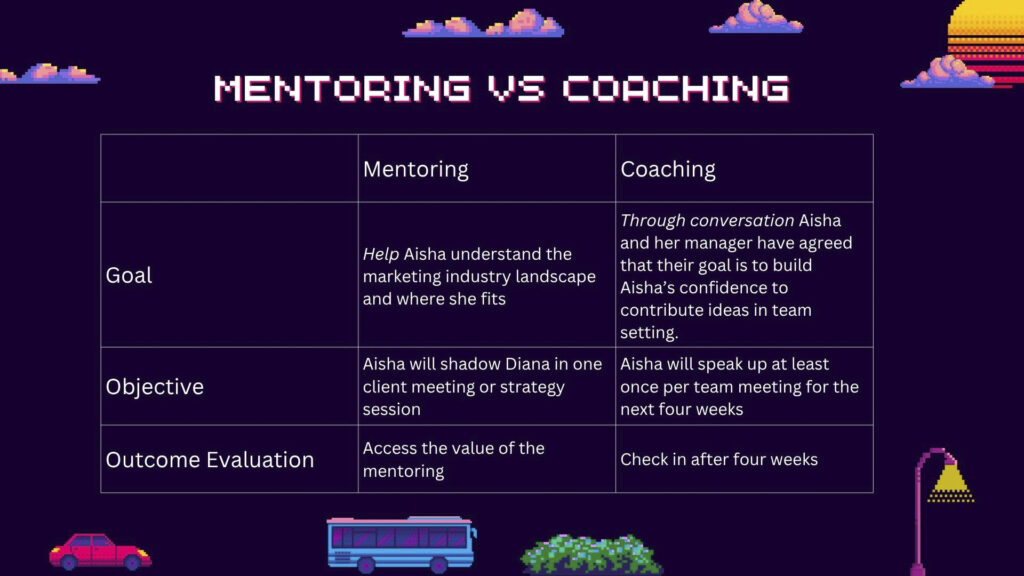
Coaching and mentoring both make valuable contributions to employee development, but they address fundamentally different needs. Mentoring answers the question, “Where do I fit?” It helps Aisha build industry knowledge, develop professional judgement and understand how to navigate her career.
Coaching, on the other hand, explores questions such as, “Why do I become quiet when feedback is given?” or “What is preventing me from performing at my best?” Through thoughtful questioning, coaching supports Aisha in setting meaningful goals, reflecting on her progress, and identifying practical actions that enable her to develop confidence and find solutions that work for her.
However, it is important to remember that coaching is not an interrogation, nor is it an attempt to solve the problem on behalf of another person. Instead, it is guided by the belief that everyone has the capacity to strengthen their self-awareness, draw on their own inner resources, and find solutions that work for them.
Below is a brief summary of one of my early coaching sessions when I first started working. Rather than focusing on the specific details of the conversation, I have highlighted the questions my coach asked and how they guided the progression of the session.
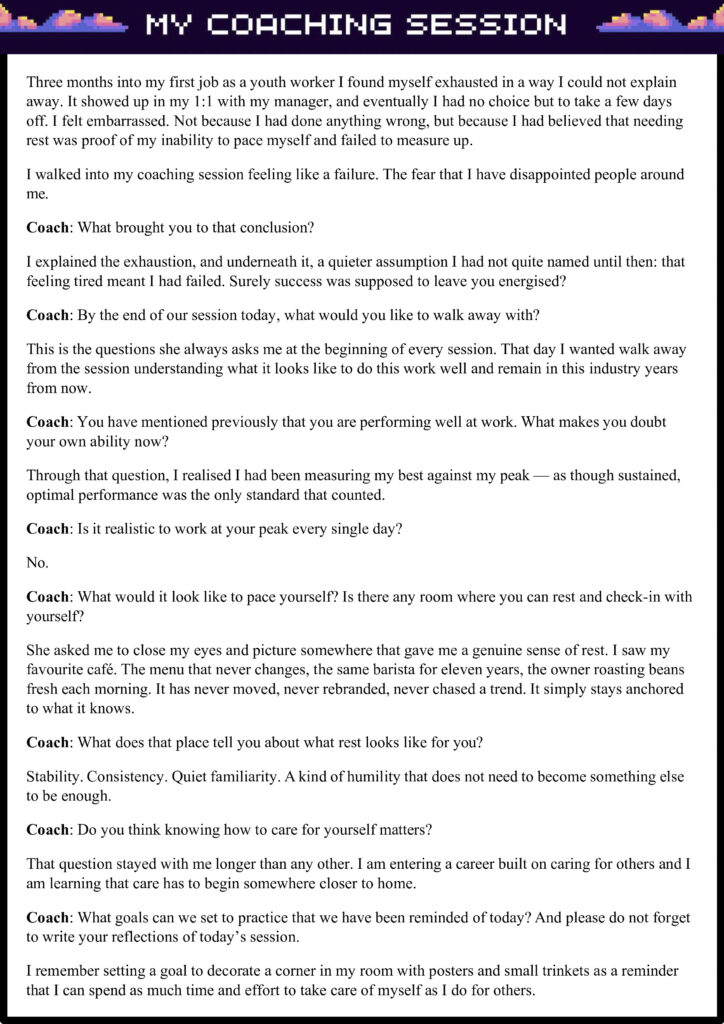
I often left coaching sessions with more questions than answers, but they were questions that encouraged me to think for myself and exercise my own autonomy. My coach had a remarkable ability to reflect my thoughts back to me more clearly than I had expressed them myself. She never dismissed my feelings or told me what I should think or do. Instead, she trusted that I already held the answers within me. She reminded me of my past achievements, my values and character, and encouraged me that that is what will get me through my current challenges.
That, ultimately, is what coaching does. It strengthens a ones’s confidence, self-awareness and resilience, one question at a time. Its purpose is not to solve the problem on someone’s behalf, but to equip them with the confidence and capability to navigate it themselves; to remind them of who they are. By the end of a session, the challenge itself may not have changed, but I have. I leave with a renewed sense of confidence in who I am, greater clarity about my next steps, and a stronger belief in what I am capable of achieving.
Coaching as a method of engaging Gen Z
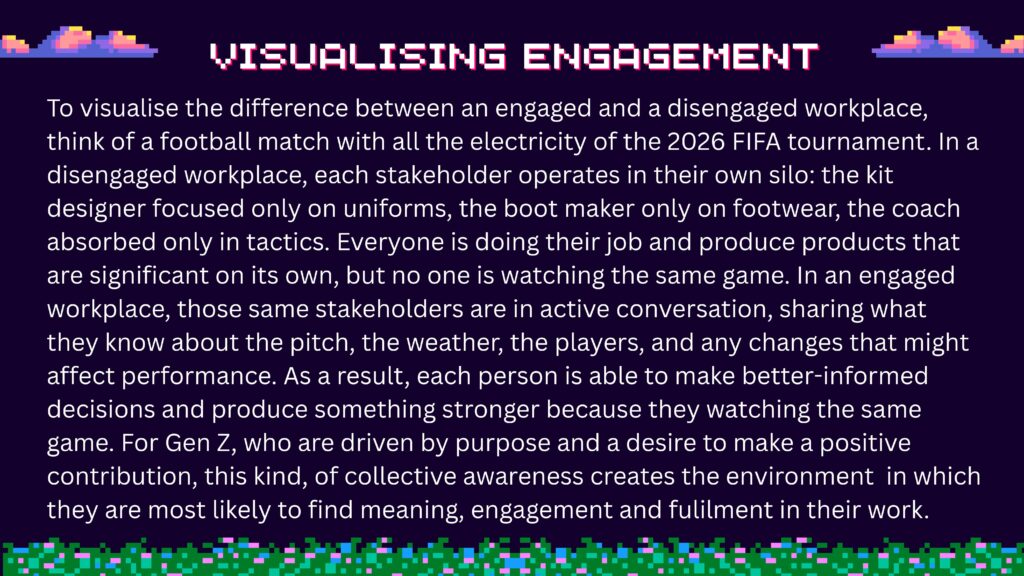
According to Gallup, engagement can be understood as “the psychological attachment workers have to their work, their team, and their employer”. Over the years, engagement has remained one of the strongest predictors of employee retention, productivity, profitability and organisational performance. Considering what we know about Gen Z (their strong sense of purpose, commitment to work-life balance, concern for personal well-being, and desire to make a positive contribution) creating an engaged workplace may be key to rethinking leadership and workplace culture.
What makes coaching particularly relevant is the evidence that engagement among younger employees increases when managers adopt the role of coach rather than critic. This is more than a stylistic shift. Moving from boss to coach means moving from telling to asking. It involves replacing one-way instruction and hierarchical direction with an ongoing dialogue in which employees are encouraged to think, contribute and take ownership of their work.
Just as importantly, this approach signals something that matters deeply to many members of Gen Z: that their manager is genuinely invested in their development. When employees experience this kind of consistent, two-way conversation, work begins to feel less like a series of tasks and more like something they are building together with their team and organisation.
Coaching as a tool for being curious about Gen Z
The success of coaching rests on one core assumption: that people are capable. Coaching begins with the genuine belief that Gen Z already possess the capacity and resources to succeed. It is less about giving answers or transferring knowledge and more about helping people feel seen while drawing out the potential that already exists within them.
One of the most powerful tools a coach brings into that environment is curiosity. It means asking about a young person’s experiences, listening deeply, and following up with thoughtful questions that help them recognise patterns, make connections, and apply what they already know to the challenges in front of them.
Here are three questions my coach has asked me time and again:
What would you understand about yourself if you solved this?
When we are faced with a problem our natural instinct is to solve it, get answers or make decisions. However, this question shifts the focus from the problem to the person. It creates an opportunity of meaning-making where one can interpret their challenges through their experiences, values and beliefs. It encourages the employee to realise or learn something about themselves so that the self-understanding outlasts the specifics of the problem.
If Aisha figured out how to speak up in meetings, what would that teach her about herself? Has she been equating silence with safety? The next step could be working together to create a space that she feels safe to speak up in meetings.
What would your 50 year old self tell you today?
In a state of stress and anxiety it becomes harder for us imagine how we will feel tomorrow or in a couple of hours. Even psychological findings show that we are bad at predicting the intensity and duration of our future emotions.
So, by putting ourselves at a great distance away from the issue at hand we are reassuring our nervous system that we exist beyond the current situation. Also, giving ourselves advice is a self-generated wisdom which comes from what we have experienced and will be received with less resistance than external advice.
Perhaps Aisha may feel that she will always freeze in meetings, but introducing distance assures Aisha of her existence in the future, help her calm her nervous system and start the conversation of how can we move forward together.
What is the worst possible outcome and honestly, how likely is that to happen?
When we are stressed, the mind is unable to distinguish what is possible and the probability of it happening. It leaps to a worst-case scenario without evidence and then treats that scenario as though it is inevitable rather than merely imagined.
By asking the employee to articulate the worst outcome the overwhelming feelings of stress and anxiety is manifested as a hypothetical outcome, giving the emotions a destination to settle.
The second part of the question asks forces us to collect evidence, reminds us of the our past experiences and our skills to calibrate the actual odds. Most times the worst possible outcome is not the worst and the inevitability of the situation is low. Furthermore, it will also give the managers a chance to find ways to alleviate the problem once it becomes identifiable.
There are thousands more questions that could be asked and one very important core foundation to it. We need to remember that we are asking these questions because we believe they have the ability and experience to overcome the obstacles. We believe that they do not need another person telling them what they need and what to do, but rather approach with curiosity of how they will grow personally and professionally through this experience.
Takeaway
Gen Z is not a problem to be solved. It is a generation entering the workforce with a clearer sense of what thay value, what they are willing to contribute, and what they need in return. They are asking important questions about what work should look like, what leadership should feel like, and who organisations ultimately serve. Those questions deserve thoughtful engagement rather than management strategies designed to contain them. Recognising that shift is where effective leadership begins.
Coaching is one of the most practical responses to this changing workplace. It builds engagement from the inside out, supports the development of employees at every level, and creates a culture in which people do not simply show up, but genuinely contribute. At its heart, coaching communicates a simple but powerful message: I believe you already have what it takes, and I am here to help you discover it.
For organisations willing to make that investment, the return extends far beyond the development of Gen Z employees. Coaching cultivates stronger leaders, more engaged teams, and workplaces where curiosity, trust and shared purpose become part of the culture. In an era where the future of work continues to evolve, that may be one of the most valuable investments an organisation can make.